


Captain Blood (1935): The Criterion Collection

Many aspects of silent film can be found throughout the history of cinema, even up to now; even if the silent era finished almost 100 years ago in Hollywood. Co-director of South West Silents and Film Noir UK James Harrison comments on a film that hales back to the silent action film of the 1920s thanks to a new release by The Criterion Collection. Plus, you get a chance to win a copy of Criterion's new release of Captain Blood (1935).

There is always something incredibly fun about Captain Blood (1935), although, when thinking about it, there is something always fun when it comes to the action films starring Errol Flynn particularly his Warner Bros. action titles.
Originally a vehicle for Robert Donat (Donat had just starred in 1934’s highly successful adaptation of The Count of Monte Cristo) who later dropped out of the role of Peter Blood (aka Captain Blood) due to ill health. With Donat out, Warner’s looked around the studio lot and beyond to find a replacement, even the likes of Clark Gable being suggested at one point.
In the end, it was totally by chance, that the very much unknown Australian born actor Errol Flynn was offered the role after being spotted in Warner’s British production of the now lost Murder at Monte Carlo (1934). On a side note; Flynn’s film debut was never released in the US and can now be found on the BFI’s 75 Most Wanted Films.
Flynn, at this point, was all but perfect for the role. A young, sharp, good-looking, athletic figure who would be able to jump out of a lover’s bed into a full on action scene. If Hollywood needed a Douglas Fairbanks figure for the 1930s, then Flynn was the perfect candidate to take over.

As a film, Captain Blood has every element of what a Douglas Fairbanks film from the 1920s had and what an action-packed swashbuckling film needed for the 1930s. Plenty of romance, thanks to the electricity between Flynn and the up-and-coming star that would be the great Olivia de Havilland. There is also plenty of villainy in the shape of character actor Lionel Atwill (do check him out if the name doesn’t ring a bell) as well as the great Basil Rathbone. There’s even a branding scene!
Then there is the production team itself. Throw in Hal Mohr and Ernest Haller’s beautiful cinematography, art direction by Anton Grot, costume design by Mil Anderson, special effects by Fred Jackman and Erich Wolfgang Korngold’s amazing music (directed by Leo F. Forbstein) then you have a perfect combination of craftwork that none other than Hollywood could produce.
Then of course there’s director Michael Curtiz. Curtiz really doesn’t need an introduction given the great creative output before Captain Blood (Private Detective 62 (1933), Jimmy the Gent (1934), Black Fury (1935) and Front Page Woman (1935)) and what was to come (The Charge of the Light Brigade (1936), The Adventures of Robin Hood (1938), Angels with Dirty Faces (1938), The Sea Wolf (1941) and Casablanca (1942)), but Captain Blood is a perfect example of Curtiz’s signature work as a director.

Curtiz brings his wonderful visual camerawork style to Captain Blood and it really does bring a lot of energy at points which any other director would let scenes fade away.
But, as mentioned briefly above, the foundations of a film like Captain Blood go further back than the success of 1934’s The Count of Monte Cristo and Treasure Island (1934) starring Lionel Barrymore. These are the two titles that are mentioned in the accompanying documentary (more about that below) that started the whole Swashbuckling craze that American Cinema had in the 1930s/1940s. If anything, Captain Blood is a film which most certainly doffs its tricorne hat ten years earlier, to the silent era.
The later action films of Douglas Fairbanks can most certainly be seen throughout Captain Blood. And lest we forget; that this is the second adaptation of Rafael Sabatini’s 1922 novel ‘Captain Blood, His Odyssey’ with the 1924 version of Captain Blood directed by British born David Smith and starring J. Warren Kerrigan, Jean Paige and Charlotte Merriam. In fact, the 1924 version was produced by Vitagraph (on the East Coast) which later came under ownership of Warner Bros. only a year later after the release of the first Captain Blood in April 1925. My only hope is that Warner’s would try and do something in regards to the 1924 version; even if survival prints seem to be incomplete.

But look, this is very much the 1935’s Captain Blood time to shine again and the Criterion Collection’s release doesn’t disappoint. A film which is over 90 years old the film looks and sounds incredible. Then comes the extras.
A commentary by Alan Rode, author of the fantastic Michael Curtiz: A Life in Film, is very welcome and incredibly informative as you would expect.
Then there is the documentary which was originally released as part of Warner’s DVD of Captain Blood in 2005. Starring the likes of Rudy Behlmer, Lincoln D.Hurst, Robert Osborne and Bob Thomas, this is very much a fast passed classic example of 2000s extra feature ‘featurette’ which seems more of a rush of information than anything else. For example, Rudy Behlmer is only able to get the odd sentence in before Lincoln D.Hurst or Robert Osborne is cut in to basically finish Behlmer’s sentence off before we cut away to still connected to the film. Terribly dated (only 20 years ago now) whip pans of production photographs with some bizarre spinning and zooming also appear along the way and really does showcase the factorylike conveyor belt that studios were doing at the time to add in an extra of sorts for their brand-new DVD release.
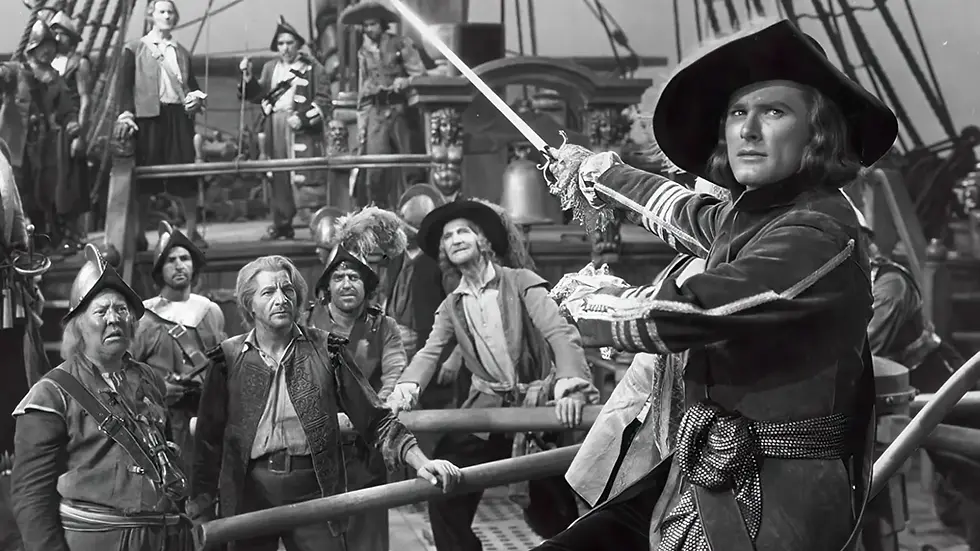
But, and this is an important part, the ‘featurette’ does what it needs to do, it tells you the entire backstory of the production from the start until the end. The entire history of the 1935 Captain Blood is all wrapped up in 20 minutes. And while the piece gives you good background to Captain Blood (although the original silent film version is not mentioned at all) the 20 minute doesn’t give the viewer any time to think whatsoever. The featurette is a piece of history in itself now.
But look, 1935’s Captain Blood is an action-packed masterpiece. A classic example of what Hollywood could muster together under the old school studio system in the 1930s. And while I’m more of a fan of a future collaboration with Curtiz and Flynn, The Sea Hawk (1940), a film which I find more fast paced than Captain Blood; we wouldn’t have The Sea Hawk without Captain Blood. Highly recommend this new release by Criterion for the film alone!
Any chance of The Sea Hawk at some point Criterion?!
Thanks to the Criterion Collection UK team we have a brand new copy of Captain Blood (1935) up for grabs, as well as a Criterion tote bag! Just send us your answer to the question below via our contact page by mid-night on Sunday 1st February to be in with a chance. Good Luck!
Question: Which city was film director Michael Curtiz born in?



Comments